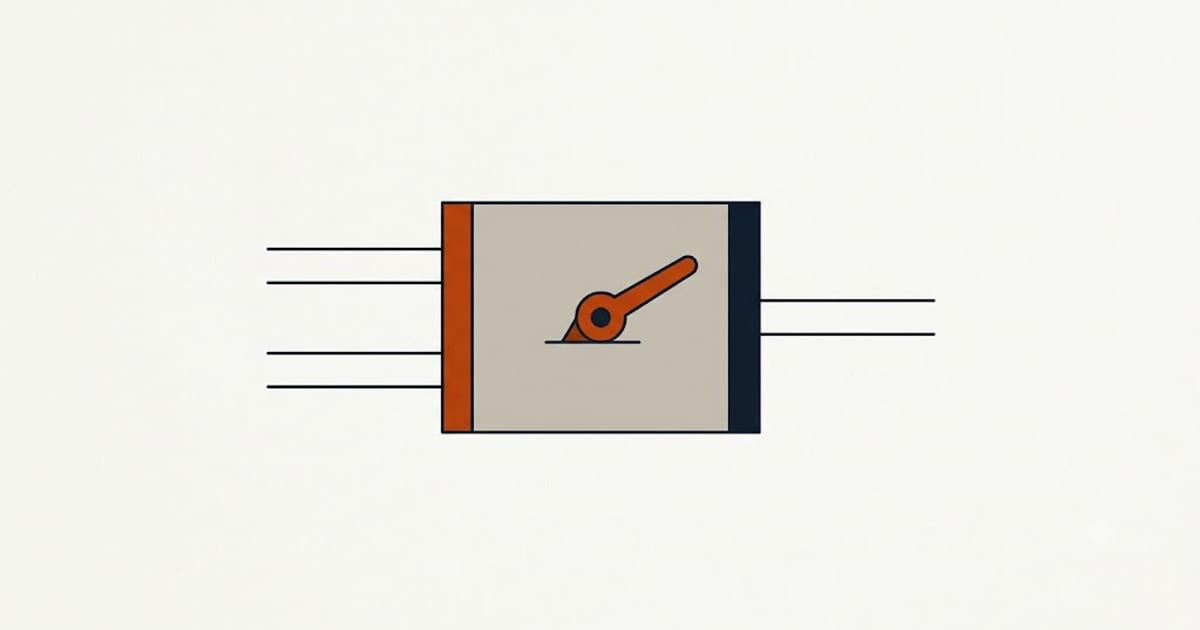
The engine is running. The house is dark. Those are two separate systems, and the fault is almost always in the second one.
What is supposed to happen
The controller senses utility loss, waits a few seconds to confirm it is real, starts the engine, lets it warm up and stabilise for 10 to 30 seconds, and only then commands the transfer switch to move the house from utility to generator.
If any step in that chain stops, the engine still runs. It just runs unloaded, which is why it sounds fine.
1. It has not transferred yet
Before anything else: wait. The warm-up delay is deliberate — transferring onto an engine that has not stabilised delivers bad power to the house. Thirty seconds feels much longer in the dark.
2. The transfer switch is in the wrong position
On a manual switch this is the whole answer surprisingly often. The handle has three positions — utility, off, generator — and the middle one is a real position that looks engaged.
On an automatic switch there is usually a manual override lever, and if it was left in the manual position after service, the controller cannot move it. Look for the override and confirm it is set to automatic.
3. The generator's main breaker is off
Standby generators have their own output breaker, on the unit itself, separate from anything in the house. It trips on overload and it gets switched off during service.
The engine runs perfectly with it open and produces nothing. This is the single most common cause after position, and it takes ten seconds to check.
4. It is producing no voltage
The engine turns, the alternator does not excite. Causes range from a failed voltage regulator to brushes to a lost residual magnetism after long storage.
The distinguishing sign is that the unit's own controller usually reports a fault or an undervoltage condition rather than showing normal operation.
5. It transferred and then dropped out
Something overloaded it. The generator sags, the controller sees undervoltage or overcurrent, and it drops the load to protect itself — sometimes retransferring, sometimes shutting down.
The clue is that there was power for a few seconds or minutes, most often just as a large motor started. That is a sizing or load-management question rather than a fault, and the fix is a shed module or a soft starter rather than a repair.
What to check, in order
- Wait a full minute from engine start.
- The generator's output breaker on the unit itself.
- The transfer switch position, including the manual override on an automatic one.
- The controller display for a fault code — write it down before clearing it.
- The main breaker in the house panel, which sometimes trips during the outage.
Beyond that it is a technician's job, and the fault code is the most useful thing you can hand them.
Why this shows up on the night it matters
A standby generator exercises itself weekly — typically for 10 to 20 minutes — but that exercise cycle usually runs without transferring. The engine, the battery and the fuel all get tested. The transfer switch does not.
So a switch that has failed can sit undetected through a year of perfect-sounding weekly exercises.
Ask for a load test at the annual service, not just an exercise. It is the only thing that proves the whole chain works, and it is what separates a generator that runs from a generator that helps.
The battery is the other silent failure
Most standby generators fail to start on a dead battery, and the battery is a consumable with a life of three to five years. The weekly exercise charges it, which masks a battery that is nearly gone right up until the day it has to crank a cold engine.
If the unit is more than three years old and the battery has never been replaced, that is the cheapest insurance available.